French mothers, feminine expectations and the good girl dilemma
Growing up with a French mother meant being raised with a very specific set of values about femininity, culture, and how to be a “good girl.” My mother is attractive, the literary type, and deeply attuned to the importance of appearances and excellent manners.
Behaving like a daughter from a good family (“Tochter aus gutem Hause”)wasn’t just an idea; it was the unspoken script of my childhood.
Manners mattered. A lot.
My mother’s values and socialization
My mother’s way of conducting herself reflects her French upbringing — rooted in intellect, literary pursuits, and the enduring belief in the power of presentation. She taught me that a woman’s looks and manners weren’t optional; they were crucial. She shared subtle (and not so subtle) messages with me: dress appropriately, don’t stand out (“this orange-red dress makes you look like a bonbon”), don’t put on extra weight, find a husband, settle down.
A small but telling example: I hate ironing shirts with a passion. To me, it is a waste of time. Not so my mom. She always carefully ironed her blouses.
Not surprisingly, the person I can best discuss my childhood socialization with is Julia, who shares my parental combination: a French mother and a German father. When I talked to Julia about my mom’s current fixation on male beauty, Julia recently said something that struck me:
“Looks were women’s capital back then.”
Julia’s mother — 10 to 15 years younger than mine — holds similar beliefs about the importance of being attractive and having a romantic partner.
Interestingly, not all French women born sometime between 1943 and 1960 share this obsession with looks or this strong need to appeal to the opposite sex, to seduce (“le jeu de la séduction”). Josette, my Parisian godmother, for instance, is unapologetically practical. She manages her money and the family finances with confidence. Now in her eighties, she still lives independently in her own home.
My Parisian godmother has always role modeled that women can be both capable and commanding — a lesson I’ve internalized thanks to her.
And my mom’s best friend Suzanne, also a French woman, combines it all. She likes to dress up — and she is very assertive.
We can look at Suzanne’s collection of vintage Hermès silk scarfs, but also plot how I can outsource more of the care work for my mother (because yes, care work is work).
When I put my mom’s views on femininity and a woman’s role into a historical context, I am less judgmental towards her. Yes, my mother stopped working as a teacher once she had children, but she was rebellious in her own way prior to that. She got an au pair job in Switzerland in the 1960s to escape the narrow confines of her French village, an unwanted engagement to her brother’s friend, and to earn money. She then packed up and moved to Toronto in the mid-1960s. Adventurous and unconventional for her time, she broke the rules in ways that quietly defied the “good girl” mold.
Now that I am 47, I notice how difficult it is to not succumb to good girl behavior. In my view, society still puts a premium on women being docile and compliant. I navigate a German societal context that in my perception, hasn’t changed all that much from 1960ies France — a societal context that subtly suggests which female behaviors are desired (and which traits are shunned).
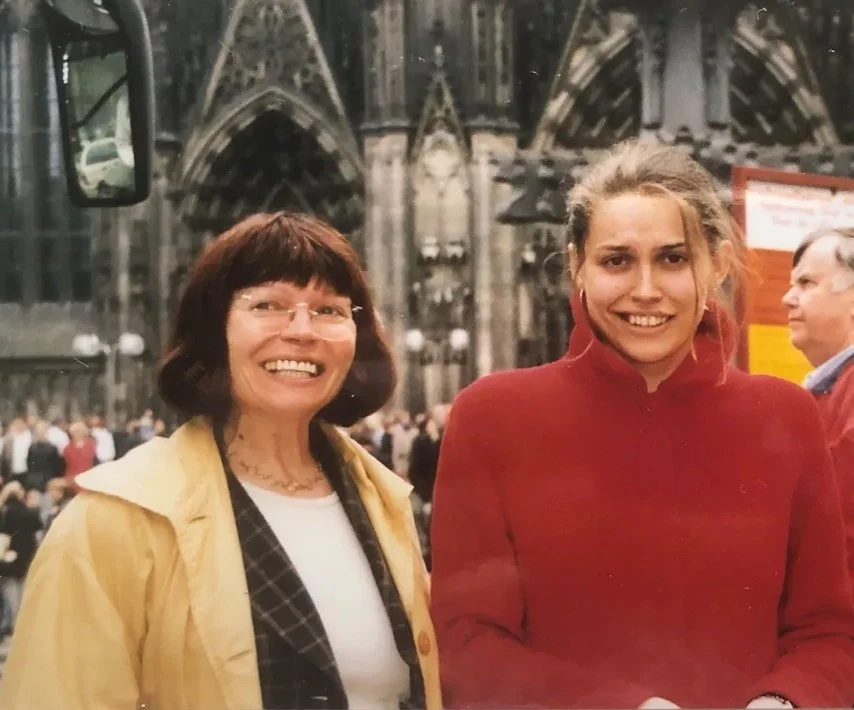
The author and her mother, Strasbourg, 1999.
When your personality clashes with being a good girl
Traits like empathy, docility, and nurturing don’t come naturally to me. Sometimes, I feel bad for not being “soft” or “emotional” enough. As an INTJ (as per the Myers-Briggs personality categorization), I thrive on creating solutions, I am analytical, and far more inclined to approach situations logically than emotionally. In addition, I’ve never been afraid to speak up — whether it was to a teacher when I was 10 or to challenge the status thinking of managing directors at the banks where I worked. One could say I am aware of my power and often used my voice to challenge authority and defend the powerless.
That’s not exactly the “good girl” way of doing things.
The harm of being too good
The book Good Girls Don’t Get the Corner Office by Lois P. Frankel highlights how behaviors many women are socialized to adopt — like being overly polite, avoiding conflict, or seeking constant approval — can limit their success in the workplace. These “good girl” traits, while often rewarded in childhood, can lead to self-sabotage when navigating professional environments. Coincidentally, I read this book a few years ago, when I worked in a male-dominated corporate environment. It helped me recognize some of my people pleasing patterns and asssess when being “good” serves me — and when it doesn’t.
Reflections on more nuanced brands of femininity
For most of my life, I equated being female with being powerless. I saw how “good girl” behavior — serving others, being overly accommodating, and staying silent — could turn toxic and self-destructive. And it’s not only my French mom who displayed these behaviors — my favorite German aunt went above and beyond, caring for her unfriendly sick mother-in-law, or hosting an exquisite family reunion every 25th of December, complete with self-baked cakes. In my perception, she took care of everyone but herself.
Again, my friend Julia acted as the voice of reason, the person who is able to evaluate this behavior from a neutral point of view. She reminded me that certain good girl traits, like being able to accommodate others or creating a beautiful home, can also be viewed as powerful. She pointed out that Martha Stewart, for example, built a business empire grounded in home and hospitality. From cooking and entertaining to crafting and gardening, Martha Stewart turned traditional domestic arts into a multi-million-dollar brand. If you ever watched “The apprentice” featuring Martha, you are aware that docility is the last trait you’d associate with her personality.
Julia’s input reminded me of conversations I’ve had with other friends in the past three years — conversations which opened my eyes to a completely different perspective, a different brand of what it means to be female.
My friends Adrienn in Zurich and Melissa in Berlin didn’t see womanhood as a limitation. They viewed it as a source of power.
They described femininity as a force that could inspire, nurture, and lead in ways that were unique and irreplaceable.
These conversations were transformative for me. They made me question my assumptions and reframe how I view being a woman — not as a limitation, but as a different kind of strength. This change of perspective also impacted my need to use the limiting concepts of “good girl” versus “bad girl”. Could there be something in between?
Adopting a playful approach to good girls and bad girls
My 81-year-old French mother, in her own way, continues to be my greatest teacher. As her dementia progresses, I’ve noticed something fascinating: she’s shedding some of the learned “good girl” behaviors.
Gone are the unspoken rules about accommodating everyone or maintaining perfect manners.
Now, she sometimes just insists on what she wants, speaks up for herself, and becomes impatient when things don’t go her way. And her mind likes to dwell on male beauty. She shares stories with me of her (imaginary) new male friends whom she encourages to find a lover. She tells me how beautiful they are and that she feels sorry for them for being single. I play along.
It’s a side of her I didn’t witness as a child and teenager. Yet, it teaches me a lesson: it’s okay to take a more playful approach to these roles. I can lean into the “good girl” persona when it serves me — graciously pouring coffee at a funeral or engaging in small talk about art with a teenager. My intuition tells me when I have overdone it and when being “good” exhausts me and does not feel authentic anymore. And I can also speak up, unapologetically, whether I’m negotiating my consulting rate or advocating for someone who feels powerless. I can express my anger and stand up for what I deem is right.
I make the rules.
Coming to terms with the good girl socialization
At 47, I reflect deeply on my mother’s influence and my path. I used to think I wasn’t the literary type — my mom was. But as I write more, share my thoughts on LinkedIn, and hear people say they enjoy my storytelling abilities, I realize that I can be “the literary type” but also earn money and be assertive. I’ve inherited my mother’s creativity while finding my voice. I also inherited a penchant for Hermès silk scarves, Chanel lipstick and Louis Vuitton bags (pro tip: only buy them second hand!).
Oh and the French girl mode? I lean into that when it serves me — for example, when I attend my business school’s events on fashion and artificial intellligence in Paris and have to “leave a good impression”. Merci, Zette (that’s my mom’s nickname)!
“My mission, should I choose to accept it, is to find peace with exactly who and what I am. To take pride in my thoughts, my appearance, my talents, my flaws, and to stop this incessant worrying that I can’t be loved as I am.”
— Anaïs Nin
The courage to create your own brand of femininity — good girl, bad girl, and everything in between — is the real lesson. You make the rules.